WordPress Pros and Cons: Complete Guide Before Building a Website
Discover the real pros and cons of WordPress. Learn its advantages, limitations, and whether WordPress is the right choice for your next website.
If you spend even a little time around websites, sooner or later you will hear someone say, “Just build it on WordPress.”
And honestly, there is a reason for that.
WordPress has been around for years and powers everything from personal blogs to company websites and large online platforms. But popularity does not automatically mean it is the perfect choice for everyone.
Some people love WordPress because it gives freedom.
Others avoid it because it needs maintenance.
So before you decide to build your next website on WordPress, here is the real picture.
Why So Many People Choose WordPress
When people first discover WordPress, the biggest surprise is usually how much you can do without writing code.
You install it, choose a theme, create pages, and suddenly you already have a website.
That simplicity is what makes WordPress attractive.
But that is only the beginning.
1. It Is Beginner Friendly
You do not need to be a developer to start.
The dashboard is simple enough that most people can publish content, update pages, upload images, and manage a website after spending a little time with it.
That makes WordPress a good starting point for freelancers, students, business owners, and creators.
2. You Get Real Ownership
This is something people do not talk about enough.
With WordPress, especially self hosted WordPress, your website is actually yours.
You choose where it lives.
You decide how it looks.
You control what features get added.
You are not trapped inside somebody else's platform.
That freedom becomes more valuable as your website grows.
3. You Can Build Almost Anything
Many people still think WordPress means blogging.
That stopped being true years ago.
Today you can build:
• Portfolio websites
• Business websites
• Educational platforms
• News portals
• Booking systems
• Ecommerce websites
• Membership platforms
• Custom web applications
WordPress grows surprisingly well when built properly.
4. Plugins Save Massive Amounts of Time
One of the best parts of WordPress is that you rarely have to reinvent things.
Need SEO?
Install a plugin.
Need forms?
Install a plugin.
Need backups?
Install a plugin.
Need speed improvements?
Install a plugin.
That speed of development is hard to ignore.
5. It Can Be Great for SEO
Search engines generally work well with WordPress websites.
Clean structure, easy content publishing, metadata control, mobile friendly themes, and optimization options make it easier to build search friendly websites.
Of course, WordPress alone does not rank websites.
Good content still matters.
But WordPress Is Not Perfect
This is the part many articles skip.
WordPress has weaknesses too.
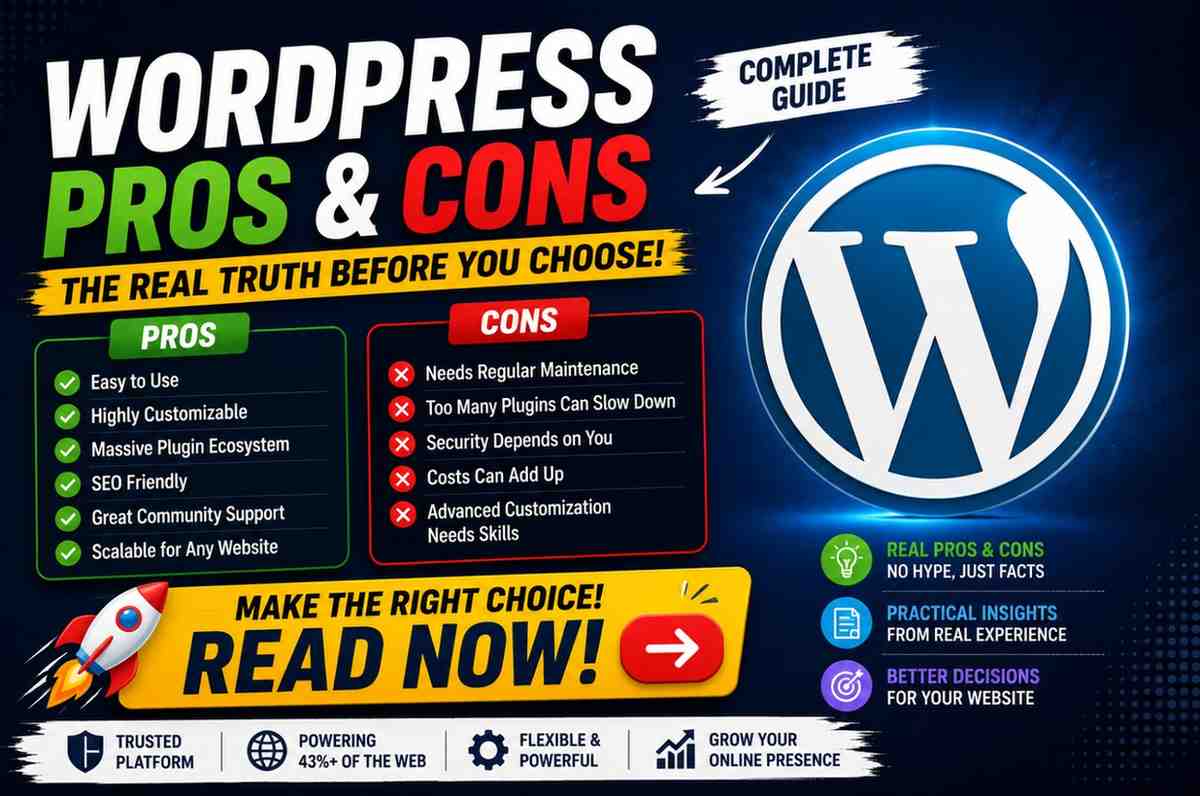
1. Too Many Plugins Become a Problem
Plugins are useful.
Too many plugins are not.
People often install twenty different plugins and then wonder why the website became slow.
A good WordPress website is usually simpler than people think.
2. Updates Never Really Stop
If you use WordPress, maintenance becomes part of the job.
Core updates.
Plugin updates.
Theme updates.
Security updates.
Ignore them for long enough and problems eventually appear.
3. Security Depends on How You Manage It
People often say WordPress is insecure.
Usually that is not the full story.
Most issues happen because:
• Old plugins
• Weak passwords
• Poor hosting
• No backups
Managed properly, WordPress can be extremely reliable.
4. Advanced Customization Still Needs Technical Skills
Building a basic website is easy.
Building something unique is different.
At some point you may run into PHP, databases, server settings, APIs, or performance tuning.
That is where developer knowledge starts making a difference.
5. Costs Can Slowly Increase
WordPress itself is free.
But real websites often include:
Hosting.
Domain.
Premium tools.
Custom development.
Maintenance.
It is still affordable, but not always completely free.
So… Is WordPress Worth It?
For most people?
Yes.
WordPress gives a rare balance between simplicity and control.
You can launch quickly today and still have room to grow later.
That is probably why it continues to stay relevant even after all these years.
If you want a website that you can actually own, customize, and scale over time, WordPress remains one of the strongest options available.
Not because it does everything automatically.
Because it gives you the freedom to build things your way.
FAQ
Is WordPress good for beginners?
Yes. Most people can learn the basics surprisingly fast.
Is WordPress better than custom coding?
Depends on the project. WordPress is faster to launch, while custom coding gives maximum flexibility.
Can WordPress handle large websites?
Absolutely. With proper setup, WordPress can scale very well.
Is WordPress completely free?
The software is free. Hosting and additional tools may cost money.
Do I need PHP knowledge?
Not for basic websites. But it becomes useful for advanced customization.
Should I use WordPress in 2026?
If you want flexibility, ownership, and long term growth, WordPress is still a strong choice.